How risk is classified, and how help is triaged for employees in distress
This document outlines Intellect’s escalation protocol for consultations with Providers and the 24/7 helpline. Intellect’s top priority is to maintain the clients’ confidentiality, ensure the safety of the clients and safeguard clients’ personal data, health information, and privacy rights.
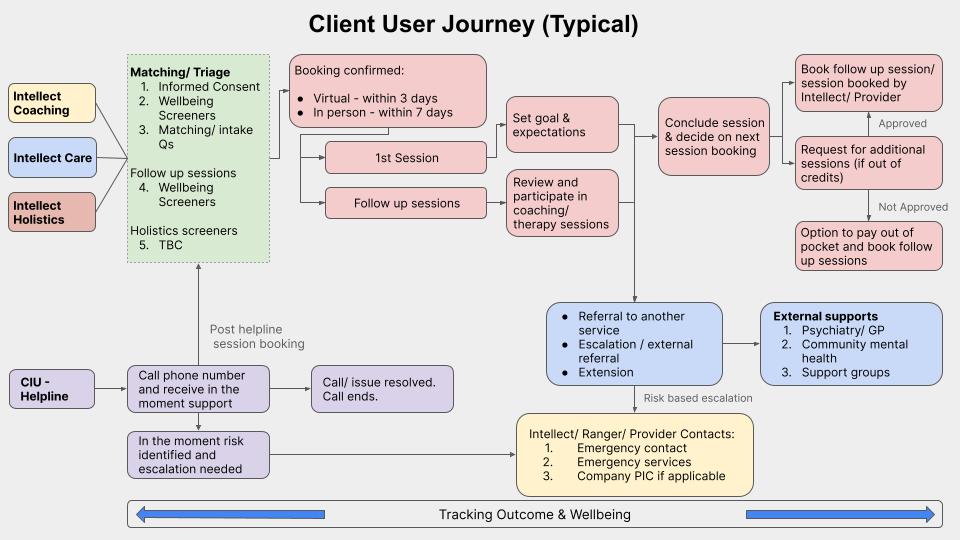
The diagram below shows the typical user journey of Intellect users. Throughout the user journey with Intellect, Risk Assessment will be conducted by Intellect at various points to ensure that the user is receiving the appropriate support for their risk level and the topic of interest.
Risk Assessment & Classification
A Risk Assessment is a combination of psychological (e.g.current mental health status) and social factors (e.g. relationship problems, unemployment etc). A Risk Assessment involves Observation of client during session (eg. body language), questioning techniques and Clinical Screeners (eg. PHQ-4, WSAS, etc). Risk levels are assigned as described:
Low
- No suicidal ideation or thoughts of harming self or others. If client has suicidal ideation, or thoughts of harming self or others, there is No intent to act on these thoughts.
- Fleeting thoughts of not wanting to live or to harm others or self but these are transitory.
- Able to exert some control over them (e.g. might verbally dismiss some of these thoughts during call).
Medium
- Suicidal ideation, and/ or thoughts to harm self or others may be present, with intention to act on these thoughts.
- No specific plan or the plan to end their life, harm themselves or others are not accessible.
- Some impairment of day-to-day functioning at home or at work.
- May result in breaking confidentiality with client’s consent to review a care plan with their next of kin contact or the relevant Specialist Teams of the company/ agency.
High
Non-Critical 1
- Suicidal ideation/ thoughts to harm others, intention and plan are present, means are available/ accessible.
- Not in-the-act when they make the call.
- Moderate to severe day-to-day functioning at home or at work.
- Clear/ visible signs of abuse.
Critical 2
- Active-suicide or homicidal, e.g. they are in the process of/ re already engaging in self-harming behaviours
- Efforts will be made to triage and develop safety plans for the client, potentially including calling their next of kin contact, if provided, to ensure that support networks are established and aware of risk. Relevant Company Teams are notified to ensure safety protocols are activated by the Company.
- A Company (ambulance/ police) will be contacted immediately to ensure safety.
Escalation Process
During the Escalation Process, the main stakeholders are:
- Intellect Provider – Clinical Psychologist/ Counsellor
- Intellects Team – Internal Clinical team managing session/ client risk
- Client’s Next of Kin – This person is nominated by the Client on the first session
- Emergency Services – The police/ ambulance
- Specialist Team of the company
Communication would be over phone call/ WhatsApp phone call and a follow up email from Intellect Provider to Intellect Intellects Team or Intellect Provider to Next of Kin/ emergency services. Once a risk level of Medium or above is assessed, Intellect may activate the escalation process on a case by case basis. While ensuring the client’s safety and wellbeing is Intellect’s top priority at all times, especially in crisis scenarios, under certain circumstances, the relevant Specialist Team of the company needs to be informed about the employee’s risk level and their safety plan. This disclosure serves dual purposes:
- To ensure the client receives the necessary care; and
- To maintain the safety of both the client, and their peers. and those around them.
Intellect’s guide to decide if the relevant Company Team is notified is based on the severity of the client’s challenges or issues and how that translates to a risk of harm to themselves, others in the organisation and the general public population.
Escalation Actions:
Intellect and Company Teams to decide on a point of contact in the Company (i.e. the Psychology/ Wellness/ Security teams/ HR/ Mental Health First Aider) PICs to be contactable 24/7 in case of urgent notification from Intellect with whom to share confidential employee information in particular crisis situations and how to share the information, i.e. by what communication channel (e.g. phone number, email, etc.). Intellect will email the relevant Company Team on the incident summary (see 6.1) for continuity of care.
Step 1: Initial Assessment
- During the session, providers will continuously assess the client’s safety and any potential risks that could negatively affect those the client interacts with.
- If the provider identifies or assesses that there is risk of harm to self, harm to others around the client or risk of harm to organisation/ society/ country, the provider should document the observed behaviour and concerns with as much detail as possible, including the date, time, specific behaviours observed. Provider should then enact the escalation protocol by informing Intellect’s Intellects team via Whatsapp call. The number is available on the Provider dashboard.
Step 2: Notification of Intellect’s Team
- Provider will inform a representative from Intellect with all relevant information.
- Confidentiality will only be broken if the team ascertains that there is significant or imminent risk of harm to self, harm to others around the client or risk of harm to organisation/ society/ country. These scenarios are in line with Intellect’s stringent escalation protocol to ensure client safety while upholding the utmost standards of confidentiality and care.
Step 3: Notification of Relevant Specialist Teams of the Company (if required)
- The relevant Company Teams will be contacted under the following circumstances:
- The client’s safety is at immediate risk, and additional support from the Company’s specialist team is crucial for the client’s care continuity.
- The case has been managed, but further steps are necessary for the client’s wellbeing, including recommendations for next steps or additional support in the workplace, with the client having provided consent for the relevant Company’s specialist teams to be informed.
- The purpose of contacting the Relevant Company’s specialist Teams is to obtain further information if necessary, or advise on subsequent steps to ensure the client’s wellbeing and safety. Consent from the client may be overridden in the following cases:
- There is significant risk of self-harm or harm to others; or
- If it’s not realistic, e.g. client has not been contactable for 48 hours and Intellect has assessed client to be high risk previously; or
- If the client is assessed to be unable to make sound decisions.
- Actions need to be taken to control access to instruments of harm (under the law or duty to warn)
- Relevant Company’s Specialist Teams will be notified via phone call within 2 hours from the time of the latest Risk Assessment. A follow up email will be sent to the POC within 1 working day after the phone call.
- Intellect may bypass seeking consent of the client to break confidentiality in situations that involve safety of others/ general public/ legal requirements. Intellect will attempt to notify client of the confidentiality being broken instead.
Tiers of Emergency Contacts within relevant Company Teams for Scenarios of Imminent Risk
- At least 2 Emergency Contacts will have to be identified (See 7.2 for details of Emergency Contacts).
- Intellect team will inform the Company’s designated 1st Emergency Contact via WhatsApp call/ phone call. If 1st Emergency Contact does not respond, the team will contact the Company’s designated 2nd Emergency Contact.
- If neither responds with 1 hour of contact, the Intellect team will contact a Company (999 / 995).
Step 4: Management of Emergency
- Relevant Company Teams may internally manage the situation, prioritising the safety of the client and who they may interact with within the Company.
- Relevant Company Teams to execute relevant internal processes
- If required, Intellect’s team may contact the Company.
Step 5: Recommendations for Intervention
- Intellect team will then provide recommendations for the Company as well as a suggested support plan, where appropriate. Adopting the support plan by Intellect is at the sole discretion of the Company.
Liability
In cases where Intellect has followed the escalation protocol, and a client who was assessed as low-risk later changes to high-risk category, or in any other event, either the Company or Intellect or its officers, partners, service Providers, therapists, contractor, or sub-contractor, will not be liable to a client, whether by indemnity, by statute, in tort, or any other basis in law or equity, for loss of data, economic loss, punitive or exemplary damages, or any incidental, special, indirect or consequential loss or damage which may be suffered by client in connection with the mental health assessment, care, treatment, or services, including any death or personal injury caused as a result of the services provided to the client.
To minimise liability, Intellect and Company should ensure that:
- Clear communication channels are established between Intellect and the Company and have frequent check-ins to co-support higher risk employees/patients.
- Company provides any necessary support or intervention based on Intellect’s recommendations.
- Intellect provides ongoing training, supervision and support to the Providers to accurately assess and manage risk.
- Regular reviews and updates of this escalation protocol.
Case Vignette 1
Role: A woman with stressful job responsibilities
Scenario: Emma is a 29-year-old woman who has been feeling pretty overwhelmed with work, it has been really stressful and is going through a difficult breakup. She lives alone and has minimal social support. She decided to seek counselling through her Company’s mental health support program provided by Intellect.
Counselling Session: During a routine counselling session, Emma confides in her counsellor that she has been having thoughts of self-harm. She mentions that the constant stress has made her feel overwhelmed and that she sometimes thinks about ending her life to escape the pain.
Key Points:
Step 1: Immediate Risk Assessment: Recognise the signs of imminent risk and document thoroughly.
Step 2: Notification of Intellects Team: Ensure timely and detailed communication with relevant teams.
Step 3: Notification of Relevant Specialist Teams of the Company (if required): Intellect team to inform relevant Company Teams.
Step 4: Management of Emergency: Make a safety plan and keep the Next of Kin informed.
Step 5: Recommendation for Intervention: Provide continuous counselling and monitor progress to support the client’s mental health and safety.
Confidentiality Framework – How and When Confidentiality is broken:
| What | Client feeling overwhelmed and feels very stressed out |
| Why | Client has expressed self harm |
| When | During or after the session, when appropriate, within 2 hours of assessing risk |
| Who | Emergency Contact (next of Kin) |
| How | Via WhatsApp or phone call if necessary. Follow up Incident Summary by email, 1 working day |
Case Vignette 2
Role: Substance Abuse
Scenario: Mark Johnson is a 34-year-old sales manager who has been struggling with substance abuse for the past three years. Initially, Mark began using alcohol as a way to unwind after work, but over time, his consumption increased significantly. In recent months, he has also started using prescription pain medication, which he obtained from a friend, to cope with mounting stress and anxiety. He decided to seek counselling through her Company’s mental health support program provided by Intellect.
Counselling Session: During a routine counselling session, Mark confides in his counsellor that his substance use has escalated recently. He has been drinking every evening and taking pain medication more frequently, leading to a growing dependence. He also expressed that he has been going into work intoxicated.
Key Points:
Step 1: Immediate Risk Assessment: Recognise the signs of imminent risk and document thoroughly.
Step 2: Notification of Intellects Team: Ensure timely and detailed communication with relevant teams where needed (Notify Mark’s company if the issue affects his work or others at his workplace)
Step 3: Notification of Relevant Specialist Teams of the Company ( if required): Intellect team to inform relevant Company Teams.
Step 4: Management of Emergency: Refer Mark for detoxification. Keep Next of Kin informed.
Step 5: Recommendation for Intervention: Provide continuous counselling and monitor progress to support the client’s mental health and safety.
Confidentiality Framework – How and When Confidentiality is broken:
| What | Client has been struggling with substance abuse |
| Why | Client has gone into work intoxicated and their safety and safety of others in the office are at stake |
| When | During or after the session, when appropriate, within 2 hours of assessing risk |
| Who | Company PIC & Emergency Contact (next of Kin) |
| How | Via WhatsApp or phone call if necessary. Follow up Incident Summary by email, 1 working day |
Appendix
Incident Summary
Incident Summary – Template to be used by the Intellect team to notify Company PIC/ Relevant teams of the escalation & follow up steps.
Have feedback or ideas?
We'd love to hear it here.